
Major Donor Fundraising: How to Strengthen Your Strategy
It’s estimated that 80% of individual donation revenue comes from the top 20% of nonprofit donors. At some organizations, the split is closer to 90/10. No matter your exact percentage, gifts from major donors are clearly critical for your nonprofit to achieve its fundraising goals and increase its impact.
However, finding major donors and securing donations from them is an involved process that can feel overwhelming even to experienced fundraisers (not to mention new nonprofit professionals) if you don’t have a solid strategy. In this guide, we’ll help you build that foundation for effective major donor fundraising by covering:
- Major Donor Fundraising FAQ
- The Best Major Donor Fundraising Strategies
- Thanking & Stewarding Major Donors
Once you fine-tune your approach to major donor fundraising, you’ll be in a position to create a strong community of high-impact supporters who are invested in your organization’s work and fund it for years to come. Let’s get started!

Major Donor Fundraising: Frequently Asked Questions
What is major donor fundraising?
Major donor fundraising is the process of building relationships with and securing gifts from supporters who are able and willing to give significant amounts of money to your nonprofit. Major giving is important for organizations of all sizes and missions because these contributions make up such a large chunk of your overall fundraising revenue and, therefore, can be the deciding factor in how much you can do to further your mission in a given year.
While all contemporary fundraising efforts are most successful when they have a relational component, major donor engagement is especially reliant on relationship-building. Major donors are generally inclined to give to nonprofits that not only align with their values and philanthropic priorities, but also express genuine, individualized care for their supporters.
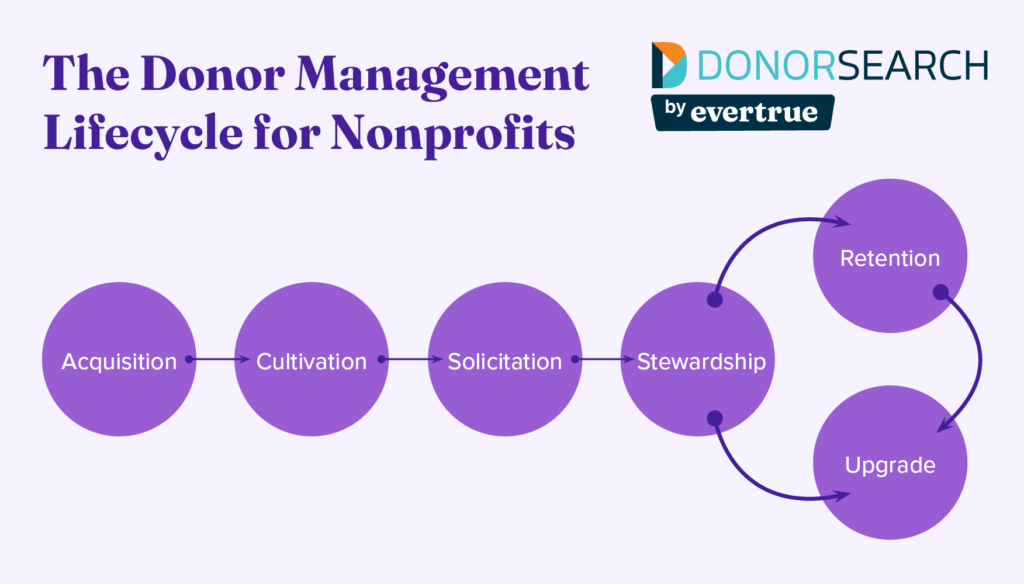
Major donor acquisition involves significant research and targeted outreach, and cultivating a potential supporter to the point that you can solicit a major gift often takes weeks or even months. However, it’s worth the effort to move them through these initial stages of the donor management lifecycle (and steward them effectively) so that you can retain and potentially upgrade their support long-term.
What amount does someone have to give to be a major donor?
Generally speaking, major donors are supporters who give a significant amount to your nonprofit. However, what amount is considered “significant”—and therefore, who your major donors are—depends on your organization’s size and scope.
To determine your nonprofit’s major gift threshold, follow these steps:
- Make a list of all of your organization’s donors and donations from the past year.
- Order the donations on the list from largest to smallest.
- Take the average of the largest gifts—smaller nonprofits may just use the top three, while large organizations might include 10 or more.
In most situations, this average is a solid starting point for your major gift threshold. The exception is if one gift is so large that it appears to be an outlier in your data. For instance, if you got one $200,000 donation last year and the next gift on your list is $20,000, you may need to adjust down slightly so your threshold better reflects the contributions you typically receive. Remember also that you’ll likely have to revisit your threshold as your organization grows and brings in more gifts of all sizes.
Who is involved with major donor fundraising?
Naturally, your nonprofit’s major gift officer(s) will take the lead on major donor fundraising. This position is a specialized fundraising role that’s dedicated to major donor acquisition, cultivation, solicitation, and stewardship. Smaller organizations typically start with one major gift officer, then expand this team as their needs increase.
However, many individuals at your nonprofit will likely touch some aspect of major gift fundraising, such as:
- Prospect researchers, since larger organizations often split screening and cultivation to delegate their many major giving responsibilities.
- Other fundraisers who are leading the charge on efforts that overlap with major giving, such as annual funds, capital campaigns, and legacy gifts.
- Board members whose personal and professional connections often lead nonprofits to good major giving prospects.
- Program directors who may talk to potential major donors about their work so prospects can make informed decisions about giving to specific initiatives.
- Event planners and marketers who can use their specialized skills to assist with aspects of major donor cultivation.
- Financial professionals who record major gifts in your nonprofit’s accounting system, report them on tax returns, and use historical major giving data to project future budgets.
- Organizational leadership, due to the vital role major donors play in strategic planning and capacity building.
Especially when your nonprofit is conducting a campaign that involves soliciting many major gifts, major donor fundraising is most successful when it’s an organization-wide collaborative effort.
What tools are most helpful for major gift fundraising?
The right technology is essential to future-proof your nonprofit’s major giving program and streamline mundane aspects of the process so that your team can dedicate more time to relationship-building. Some solutions you should have in your toolkit include:
- A robust donor database where you can create individual profiles that organize your collected information on each current and potential major donor.
- A comprehensive prospect screening solution that provides accurate information on supporters’ financial capacity, mission affinity, and philanthropic history.
- A prospect generator platform to summarize prospect research insights through concise dashboards and custom AI-powered reports.
- A predictive modeling solution that uses machine learning to segment prospects based on giving likelihood insights and make recommendations for prioritizing outreach.
- Other donor engagement and fundraising tools to support the cultivation and stewardship phases of major giving.
Whenever possible, integrate these platforms so that data can transfer seamlessly between them. This unification reduces the risk of errors, saves time on manual entry, and ensures every team member has access to up-to-date major giving information at all times.

The Best Major Donor Fundraising Strategies
Now that you’re familiar with the basics of major donor fundraising, let’s look at some of our top strategies that can help your organization strengthen its approach.
1. Hire a major gifts officer and/or team.
If you are going to make major gifts a priority, you need to hire or appoint a major gifts officer. As your program grows even more, you can develop an entire major gifts team. (Remember, if this is currently out of the question for your nonprofit, you can assign a team member to take on the duties of a major gifts officer.)
Major gifts officers take the baton from the prospect researchers and help take potential donors from the acquisition stage to a point where they’re actively contributing to your organization’s work.
A major gifts officer will likely be responsible for:
- Handling major donor prospect files.
- Preparing educational materials.
- Working with the marketing team to make promotional materials.
- Collaborating with the board and other supporters to build the prospect base.
- Presenting major gift appeals to prospects.
- Making the major gift proposal.
- Following up with major donors to continue the relationship.
- Seeking upgrade opportunities when appropriate.
The role of a major gifts officer is not to be taken lightly so you’ll want an experienced fundraiser in the role. You need someone who is comfortable with taking the lead on projects and excels in a team environment.
2. Perform prospect research.
Prospect research is a process that many fundraisers use to determine who is most likely to become a major donor in both their existing supporter base and beyond their current donor community. This is usually done through a prospect screening. Screening your prospects allows you to run your list of potential donors through a database and determine if they have key characteristics that most commonly point to a major gift prospect.
Those characteristics include:
- Philanthropic indicators like past giving to your nonprofit, past giving to other charitable organizations, and political giving.
- Wealth factors like real estate ownership, stock ownership, and business affiliations.
Those characteristics each either speak to a donor’s giving affinity and capacity. Donors with both a high giving affinity and capacity are your most viable major giving prospects.
As you screen your prospects, you should also look into their planned giving potential. Planned giving is a common way for nonprofits to receive a major gift-sized donation, even when a donor does not have the present financial flexibility to do so.
Planned gifts are donations that are decided on in the present and then allocated to the nonprofit in the future. This type of contribution is often made when donors leave charitable donations as a part of their wills after they’ve passed away. Usually planned gifts are of equal size to major gifts, sometimes even larger.
Perhaps your current donors might be more comfortable promising a planned gift for the future instead of making one now, so this is a worthwhile avenue to explore.
3. Start a major donor society.
When you request a major gift, you’re asking for a big commitment. Major donors need to be carefully cultivated leading up to the solicitation and just as carefully stewarded after the gift has been made. If you want to secure a substantial donation in the first place and want that donor to stick around, you have to take the right steps to make the donor feel like they are a part of something bigger.
One way to do that is to create a branded major donor society. Your major donor society will draw new major gifts in for a multitude of reasons, including:
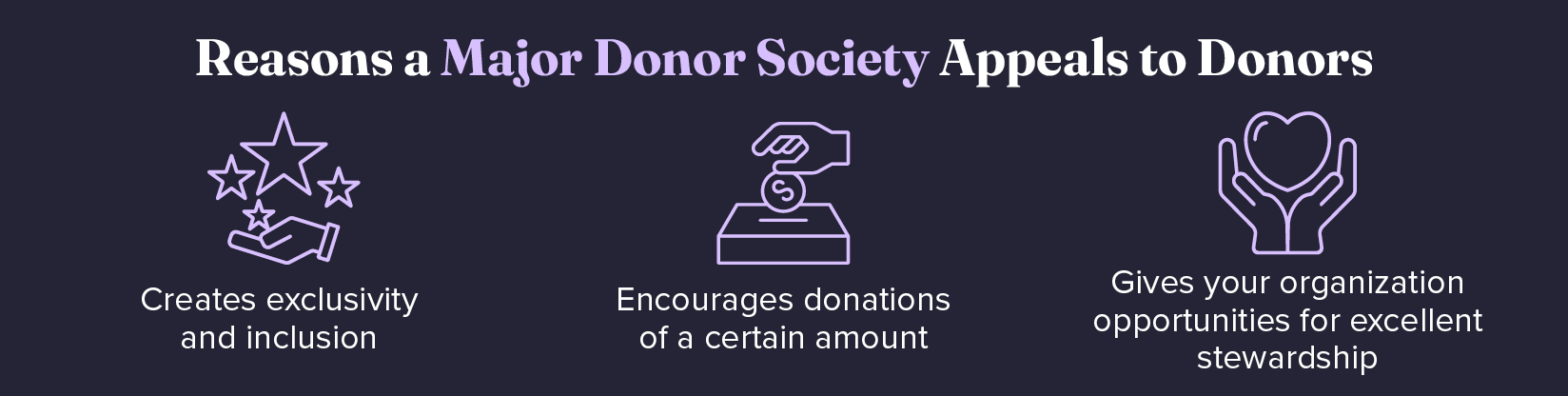
- Creates exclusivity and inclusion: People like to be part of something unique and recognized as special. A branded major donor society offers the exclusive kind of experience that many look for. You can host special appreciation luncheons with the members and key leaders in your organization. To make donors feel even more seen and recognized as part of an important group, you can also throw in additional perks, like giveaways.
- Encourages donations of a certain amount: If your major donor society is defined by the same parameters as major gifts, it will encourage your mid-tier donors to increase their gift size to hit these larger donation amounts. Imagine your major gifts are classified as anything over $20,000. A donor who wants to give a large donation and is thinking in the $18,000 range will be more inclined to upgrade their gift to cross that $20,000 major gift threshold so that they can join the major donor society.
- Gives your organization opportunities for excellent stewardship: With a branded major donor society, you have a preset group to receive a series of major gift-related communications, like a specific version of your nonprofit’s annual report. You can have a certain drip email stream and send specific direct mailings.
Essentially, the concept of a major donor society gives you a chance to build a community of major donors through exclusivity and incentives.
4. Cultivate major donors with direct mailings.
While you’ll likely want to make your major gift requests face-to-face, direct mail is an effective strategy for getting donors acquainted with your organization, too.
For example, you might send out a communication package with detailed information about the types of programs you offer and their impact on your beneficiaries. Then, when you have your sit-down meeting with a major donor prospect, they’ll already have a basic understanding of what you do and why your work is so important!
Once a major donor has given their gift, you can send an additional thank-you message in the mail (along with an annual report, newsletter, postcard, or other engagement materials).
Just remember, when sending out direct mail appeals to your highest value donors, it’s important that you invest the time, effort, and resources into making them the best quality possible. This way, you show your prospective supporters that you’re serious about getting them on board.
5. Host events catered to major donor acquisition.
Events catered to prospective major donors is a great idea for many reasons. It gets a lot of people capable of making a large gift together so that they can learn more about your organization, the beneficiaries you serve, and the kind of impact their gifts could have. Plus, your staff members (including your major gifts officer) get to know your prospects in the process.
While typically these types of events are galas or live auctions, you can also consider hosting a virtual or hybrid gathering. Just make sure you have the right tools and virtual event platform to pull it off!
No matter what format your events take, make sure your organization has the tools to manage:
- Registrations and RSVPs.
- Speakers, vendors, and venues.
- Marketing.
- Data tracking and reports.
With a smoothly-run event, your major gift prospects are more likely to have an enjoyable time and will be more motivated to support your mission. During the event, get a sense of how open participants are to making a major contribution. Then your fundraisers can focus on the candidates who have the highest likelihood of becoming donors.
6. Leverage the connections of your board.
When it comes to major donors, don’t overlook your board of directors. Your board members often have the kind of connections you need to reach out to certain prospects and begin cultivating them.
An introduction from a trusted ally is going to get your major gifts officer in the door with donors faster than starting from scratch with cold calls. People give to organizations they trust, and you want to build the foundation for that trust as early as possible.
You might even consider including a specific board member throughout the entire cultivation and solicitation process if they already have a connection with the prospect.
7. Integrate corporate matching gifts into your donation process.
Did you know that $4-$10 billion in matching gift funds go unclaimed each year? This happens simply because nonprofit supporters don’t know that these programs exist and nonprofits don’t advertise them enough. Corporate matching gifts programs describe a form of corporate social responsibility where employers match charitable gifts given by their employees to eligible organizations. Each corporation typically has its own guidelines, including gift maximum/minimum and a deadline for submitting the request.
When conducting your prospect research, take into account where the prospect works and what that company’s matching gifts policy is. If that prospect does donate, follow up with them with the resources necessary to complete the matching gift. Imagine the impact your nonprofit could have if you could double the size of a major gift you received during the same fundraising effort. Invest in a matching gifts database for an easy way to incorporate matching gifts into your fundraising strategy! You can provide donors with everything they need to find out about their matching gifts eligibility and initiate the match.
8. Prepare yourself for the long haul.
You cannot rush major gift solicitations. Sure, you might occasionally encounter a prospect who is okay with jumping right into the gift without asking questions, but those situations will be few and far between. For example, a major donor may give to your annual fund one year and then give to it again a few years later.
Instead, enter into each cultivation process with the knowledge that you’re in it for the long haul. Even after you secure the gift, if you want to keep that donor returning and incrementally upping their gift size, your stewardship will have to be just as meticulous as your cultivation and solicitation.
This is even more important during times of crisis. Your major donors might not be able to make a gift at this time, but if you continue the relationship and show that you still value their support, they may make one later down the line. You just have to be patient!
9. Track Key Major Gift Metrics
The best way to improve all of your organizational endeavors is to track and evaluate your progress using the data you collect. The right performance metrics will provide insight into what’s going well and what could use improvement so you can capitalize on your strengths, correct any issues, and build a better major giving program over time.
Some major donor fundraising metrics to monitor include:
- Total major gift asks made
- Solicitation success rate
- Average major gift size
- Total funds raised from major giving per year
- Major donor acquisition cost
- Major donor retention rate
- Major donor lifetime values
This final metric can be confusing because it’s calculated on an individual basis, but it’s important because it lets you know who your nonprofit’s most impactful supporters are. To figure out the lifetime value of one of your organization’s major donors, use the calculator below!
Thanking & Stewarding Major Donors
Once a major donor has given a gift for the first time, it can be tempting to call your work done for a while, until your next funding need arises. After all, the completed gift is likely the result of months of face-to-face meetings, phone calls, emails, and more.
But in order to build a lasting relationship with that new major donor, you have to dig into the donor appreciation and stewardship processes next. Showing your donor your organization’s gratitude and continuing to get to know them and make them feel like part of your nonprofit’s community is the best way to ensure you’ll retain their support down the road.
Let’s dive into a few tips for thanking and stewarding your donors!
Try out different thank-you ideas.
There are a number of different ways to go about thanking your major donors. Whatever you choose, you should aim to personalize your thank-you message so that each donor feels seen as an individual who your organization cares about.
Here are a few of our favorite major donor appreciation strategies:
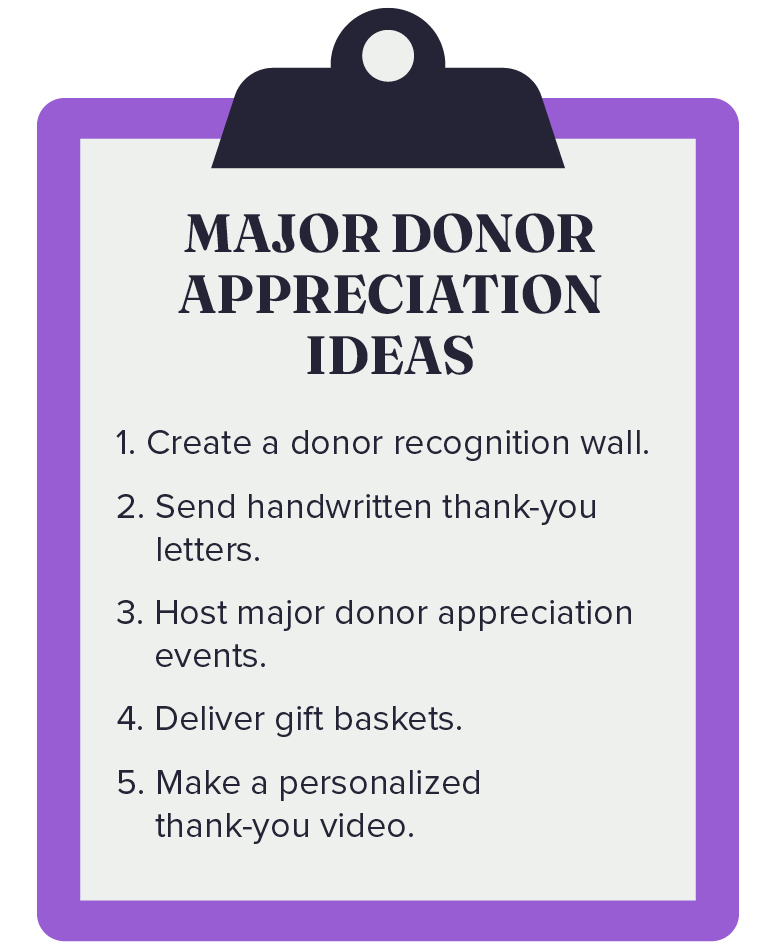
- Create a donor recognition wall. Donor recognition walls allow you to honor your major donors in a permanent, meaningful way. Today’s modern recognition displays (including both digital and physical options) are a huge leap forward from the impersonal brass plaques of the past. By building a lasting testament to your major donors, you’ll be able to convey the depth and longevity of their impact—and of your appreciation.
- Send handwritten thank-you letters. Most communication today is fast-moving and fleeting and takes a digital form. Add a personal touch to your donor appreciation efforts by writing a handwritten thank-you letter. Go the extra mile by having one of your nonprofit leaders, such as a board member or your executive director, sign the thank-you letter.
- Host major donor appreciation events. As mentioned above in the major donor society section, donors appreciate exclusivity and inclusion. Lean into this by hosting major donor appreciation events. This might be a catered luncheon or dinner, or a tour of a facility (this is especially fitting for newly-completed building projects that are part of a capital campaign). Show your donors that they’re special by providing them with an exclusive, memorable experience.
- Deliver gift baskets. Who doesn’t like receiving a little something in return for their generosity? Build personalized gift baskets for your major donors and have your team hand-deliver them. You might include gift cards, the donors’ favorite treats, or merchandise branded with your organization’s logo.
- Make a personalized thank-you video. This idea puts a fun spin on the traditional thank-you note or letter. Why not make a thank-you video instead? Get your team members together to film a short video thanking your donor and explaining the impact of their donation. Make sure to use your donor’s name throughout the video. You can get creative with this idea by incorporating music, photos of your beneficiaries, and more into the finished product you send to the donor.
Keep in mind that major donor thank-yous are not one-size-fits-all. One donor may respond well to being included on a public donor recognition wall, while another donor may just prefer a personalized thank-you letter. Use what you know about your donors and their preferences to select the best thank-you strategy for each individual.
Reach out to your major donors on a regular basis.
With any relationship, consistent contact is of utmost importance. You would never neglect to consistently reach out to your best friend, close family member, or trusted professional colleague. But some nonprofit professionals make the mistake of neglecting to reach out to their major donors on a regular basis.
Not contacting your major donors can rub them the wrong way, whether they’ve given their first or fifth major gift. It sends the message that your organization views the donor as an ATM instead of a person who cares about your cause.
Avoid this by creating a regular communication cadence. Set up recurring times to chat with your major donors via email and over the phone, and be sure to meet in person on a regular basis, as well. In addition, your conversations should extend beyond your next fundraising push. Get to know your donors as people by checking in with them about their latest family vacation, birthday, or sports team victory.
Even a small concerted effort to continue to get to know your major donors can pay dividends as you not only secure more gifts but retain that donor’s support for years to come.
Always share specific results.
Donors always want to hear about the tangible results of their gift. They deserve it, too. Your donors are giving you their hard-earned money, so they should know what it’s going to accomplish!
When it comes to major donors, this is even more crucial as the funds they are donating are that much bigger.
As you make your case to major donors the second or third time around, include your nonprofit’s accomplishments and the actual mission-based results of their past gifts. Show them that their gift of $XX, XXX helped you accomplish a very action-oriented task. For instance, if they donated $10,000, let them know that their gift was able to provide education resources for 100 classrooms. Major donors want to know that they are donating to a nonprofit that knows exactly what to do with their gift.
They’re also invested in the big picture, so as you zoom out from the nitty-gritty, talk about the effect that gifts of a certain size have on your organization as a whole. As in, “Since we were able to complete that action-oriented task, this community/group/school was able to…”
You want the path of their funds to be as transparent as possible. This way, major donors are more inclined to give. Note that sharing specific results and showing major donors the work of your organization function best in conjunction with a frank discussion of what a set amount of funds will accomplish before the gift is made.
Get major donors engaged in other ways besides donating.
As your major donors become more and more invested in your work, they’ll likely want to get involved in ways that extend beyond writing a check. Here are some ways they might want to get involved:
- Volunteering
- Providing pro-bono services to your organization
- Serving on your board
- Joining your legacy giving program
Involvement opportunities like these strengthen your donors’ bond with your organization. That is true for all small and mid-level donors as well as major donors. Create fulfilling opportunities for them to get hands-on experience with your organization and build that connection.
Final Thoughts
Every nonprofit needs a solid approach to major donor fundraising to ensure long-term success for its cause. As you apply these tips to your organization’s major giving program, keep your focus on building long-lasting relationships with every individual major donor you reach out to.
For more information on major giving, check out these resources:
- Donor Analytics: How to Make the Most of Donor Data. Explore the various data points that can inform your strategy for cultivating, soliciting, and stewarding major donors.
- How to Create a Donor Profile: Ultimate Nonprofit Guide. Dive deeper into a critical resource for individualized major donor engagement: the donor profiles in your CRM.
- 18 Best Prospect Research Tools to Find High-Impact Donors. Discover our top picks for software to support major donor acquisition and data-driven relationship-building.